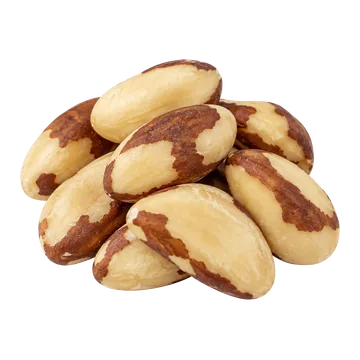
Brazil nuts, raw
Checked by us One serving: 30 g · 186 kcal
Lots of selenium and magnesium.
Go easy: aflatoxins can add up.
Worth knowing for some people: choking risk under age 4; nickel for people who are sensitised.
Good for
How we counted this
What one serving (30 g) gives you.
Your body needs enough of each of these. Past enough, more doesn’t help. Amounts are what the food databases list, not what your body absorbs, unless a row says it was measured.
The words: “A lot” means one serving gives 20% or more of Health Canada’s daily amount, “Some” 10% to 19%, “A little” 2% to 9%, “Almost none” under 2%. Strongest word first; within a word, protein and fibre lead, then the biggest share. ?
A milligram (mg) is a thousandth of a gram, and a microgram (µg) a thousandth of a milligram: 1,000 µg make 1 mg.
- A lot
Selenium
Your thyroid uses it to make its hormones.
Eaten every day, one serving would be 21% of Health Canada’s upper level for adults (400 µg a day): a ceiling for daily intake, not one meal. See Watch out.
Learn more
84.1 µg in one serving: 153% of the 55 µg a day.
Source: How much of it gets in hasn’t been measured for this food yet. NIH Office of Dietary Supplements, selenium fact sheet for health professionals
- A lot
Magnesium
Your muscles and nerves need it to work.
Learn more
105 mg in one serving: 26% of the 400 mg a day men need, 34% of the 310 mg women need. The word follows the smaller share, which is the share of the higher amount. ?
Source: How much of it gets in hasn’t been measured for this food yet. NIH Office of Dietary Supplements, magnesium fact sheet for health professionals
11 more nutrients below “a lot”
- Some
Zinc
Your immune system and healing wounds depend on it.
Learn more
1.15 mg in one serving: 10% of the 11 mg a day men need, 14% of the 8 mg women need. The word follows the smaller share, which is the share of the higher amount. ?
Source: How much of it gets in hasn’t been measured for this food yet. NIH Office of Dietary Supplements, zinc fact sheet for health professionals
- A little
Protein
Your muscles, and every other tissue, are built and repaired from it.
Learn more
4.51 g in one serving: 8% of the 56 g a day men need, 10% of the 46 g women need. The word follows the smaller share, which is the share of the higher amount. ?
Source: How much of it gets in hasn’t been measured for this food yet. Institute of Medicine 2005, Dietary Reference Intakes for Energy, Carbohydrate, Fiber, Fat, Fatty Acids, Cholesterol, Protein, and Amino Acids
- A little
Potassium
Your nerves, muscles and kidneys need it to work.
Learn more
178 mg in one serving: 5% of the 3,400 mg a day men need, 7% of the 2,600 mg women need. The word follows the smaller share, which is the share of the higher amount. ?
Source: How much of it gets in hasn’t been measured for this food yet. NIH Office of Dietary Supplements, potassium fact sheet for health professionals
- A little
Calcium
Builds your bones and teeth.
Learn more
50.3 mg in one serving: 5% of the 1,000 mg a day.
Source: How much of it gets in hasn’t been measured for this food yet. NIH Office of Dietary Supplements, calcium fact sheet for health professionals
- A little
Niacin (B3, niacin equivalents)
More than 400 of your enzymes need it to work.
Learn more
0.76 mg in one serving: 5% of the 16 mg a day men need, 5% of the 14 mg women need. The word follows the smaller share, which is the share of the higher amount. ?
Source: How much of it gets in hasn’t been measured for this food yet. NIH Office of Dietary Supplements, niacin fact sheet for health professionals
- A little
Fibre
Keeps your gut moving.
Learn more
1.8 g in one serving: 5% of the 38 g a day men need, 7% of the 25 g women need. The word follows the smaller share, which is the share of the higher amount. ?
Source: How much of it gets in hasn’t been measured for this food yet. Institute of Medicine 2005, Dietary Reference Intakes for Energy, Carbohydrate, Fiber, Fat, Fatty Acids, Cholesterol, Protein, and Amino Acids
- A little
Iron
Carries oxygen in your blood.
Learn more
0.74 mg in one serving: 9% of the 8 mg a day men need, 4% of the 18 mg women need. The word follows the smaller share, which is the share of the higher amount. ?
Source: How much of it gets in hasn’t been measured for this food yet. NIH Office of Dietary Supplements, iron fact sheet for health professionals
- A little
Choline
Your cells need it for their membranes, and to make acetylcholine, a messenger for memory, mood and muscle control.
Learn more
8.64 mg in one serving: 2% of the 550 mg a day men need, 2% of the 425 mg women need. The word follows the smaller share, which is the share of the higher amount. ?
Source: How much of it gets in hasn’t been measured for this food yet. NIH Office of Dietary Supplements, choline fact sheet for health professionals
- Almost none
Omega-3: ALA
The one omega-3 your body can’t make: it must come from food. Your cells build it into their membranes and burn it for energy.
Learn more
10.8 mg in one serving: 1% of the 1,600 mg a day men need, 1% of the 1,100 mg women need. The word follows the smaller share, which is the share of the higher amount. ?
Source: How much of it gets in hasn’t been measured for this food yet. NIH Office of Dietary Supplements, omega-3 fatty acids fact sheet for health professionals
- Almost none
Omega-3: EPA + DHA
Long-chain omega-3s, built into your cell membranes. DHA is concentrated in your brain and retinas.
Learn more
0 mg in one serving: under 1% of the 250 mg a day.
Health Canada sets no daily amount for these fats, so the daily figure here is the European Food Safety Authority’s.
Source: How much of it gets in hasn’t been measured for this food yet. NIH Office of Dietary Supplements, omega-3 fatty acids fact sheet for health professionals
- Almost none
Vitamin D
Your body needs it to absorb calcium and keep your bones hard.
Learn more
Your skin also makes it in sunlight, so food is only one of its sources.
0 µg in one serving: under 1% of the 15 µg a day.
Source: How much of it gets in hasn’t been measured for this food yet. NIH Office of Dietary Supplements, vitamin D fact sheet for health professionals
Missing from our databases for this food, so left out, not counted as zero: vitamin A, vitamin C, vitamin E, vitamin K1, thiamin, riboflavin, vitamin B6, folate and vitamin B12.
Watch out
How we counted this
Aflatoxins
Go easyLong exposure raises the risk of liver cancer.
Learn more
+8.8–130% a serving a day adds to an average adult’s intake from all food
That share is for one serving, 30 g, every day. Eaten once a week instead, the same serving adds a seventh as much: 1.3–19%, not 8.8–130%.
No amount of aflatoxins is proven harmless, so we compare with what people already take in instead of counting to a limit. We flag a food only when a daily serving would double that average.
“Go easy” here because agencies’ estimates of what an average adult takes in differ, and against the lowest of them a serving a day can double it.
One serving carries 0.02 µg (AFB1, lower bound)
How we got this
The dataset’s rating: Go easy: can double average intake
May exceed: no safe limit is set for aflatoxin B1; EFSA's 2020 reference point is a benchmark dose lower limit (BMDL10) of 0.4 µg/kg body weight/day. A daily 30 g serving adds 20.0 ng (lower bound) to 28.9 ng (upper bound), 0.286-0.413 ng/kg body weight/day at 70 kg. Against EFSA's adult mean exposure (lower bound 0.22-0.49, upper bound 1.35-3.25 ng/kg body weight/day) that is +58-130% on the lower-bound pairs and +13-31% on the upper-bound pairs, so the range reaches the doubling line. The mean in Brazil nuts is 0.6663 µg/kg (311 results, 25% quantified), the highest of the three nuts.
Selenium
Worth knowingFlagged for selenium: the tolerable upper intake level from all sources is 255 µg/day for adults, including pregnancy and lactation (EFSA 2023; Health Canada 400 µg/day). A 30 g serving carries 84 µg on the USDA listing, 33% of EFSA's level, and about 91 g a day eaten alone would reach it; with EFSA's food-only adult background (mean 35.8-65.6 µg/day) a daily serving comes to 120-150 µg, under it. Selenium varies enormously between nuts: CFIA's import checks found annual means of 2.29 to 7.69 ppm (69 to 231 µg a serving) and one sample at 34 ppm, at which 7.5 g would reach the level.
Learn more
How we got this
Nickel
Nothing to watchYou’d need about 4 servings in a day of this food alone to use up what the highest average adult intake we found leaves under the limit.
Learn more
One serving carries 165 µg
How we got this
The highest average adult intake we found already takes up about 26% of the limit. One serving a day fits in the room left.
Counted from zero, with no allowance for what adults already take in from other food, 170 g a day would reach the limit.
Why this rating: Eating it daily comes to 30 g a day, which stays within the 120 g of room left before the limit.
The dataset’s rating: Nothing to watch: under the limit
No cap: EFSA's 2020 tolerable daily intake for nickel is 13 µg/kg body weight/day, 910 µg a day for 70 kg. Eaten alone, about 165 g of Brazil nuts a day would reach it (5.51 ppm, the highest CFIA annual mean). A 30 g serving is 165 µg, 18% of the limit, and adds 75% to the adult background median of 3.16 µg/kg body weight/day (221 µg/day), under the doubling line.
Checked for cadmium, aluminum and lead: fine at normal amounts.
Cadmium
Nothing to watchYou’d need more than 100 servings a day, every day, of this food alone to use up what an average adult’s intake leaves under the limit.
Learn more
One serving carries 0.05 µg
How we got this
A serving a day adds 0.3% to what an average adult already takes in: a share of that intake, not of the limit. With that serving every day, an average adult would be at about 71% of the limit.
An average adult already takes in about 71% of the limit. One serving a day fits in the room left.
Counted from zero, with no allowance for what adults already take in from other food, 110,000 g a week would reach the limit.
Why this rating: Eating it daily comes to 210 g a week, which stays within the 32,000 g of room left before the limit.
The dataset’s rating: Nothing to watch: under the limit
A daily serving adds 0.27% to an average adult's cadmium intake (EFSA 2012 adult median, 1.77 µg/kg body weight/week; Canadian adults in 2007: 1.2-1.75), far from doubling it, so no cap.
Aluminum
Nothing to watchYou’d need more than 100 servings a day, every day, of this food alone to reach the limit.
Learn more
One serving carries 17.3 µg
How we got this
120,000 g a week reaches the limit
The dataset’s rating: Nothing to watch: under the limit
No cap: EFSA's tolerable weekly intake for aluminium is 1 mg/kg body weight/week, 70,000 µg a week for 70 kg. Eaten alone, about 121,000 g of Brazil nuts a week would reach it. A 30 g serving every day comes to 121 µg a week, 0.2% of the limit.
Lead
Nothing to watchYou’d need about 15 servings a day, every day, of this food alone to double the lead an average adult already gets. No dose is known to be safe, so doubling is where we flag.
Learn more
A serving a day adds 7% to what an average adult already takes in. There is no limit to take a share of.
One serving carries 2.46 µg
How we got this
The dataset’s rating: Nothing to watch: doesn’t double average intake
No cap: no safe limit is set for lead; EFSA's 2010 reference point is a benchmark dose lower limit (BMDL01) of 0.5 µg/kg body weight/day. Judged by what a serving adds to the average adult's intake of about 35 µg/day (EFSA 2012): 30 g at 82.11 µg/kg gives 2.5 µg, about 7%. That Polish retail mean (10 samples) is 20 to 25 times higher than CFIA import findings of 3.0-3.5 µg/kg, and the gap is not reconciled.
For some people
Health Canada: nuts are not safe for children younger than four years. A Brazil nut is large and hard.
Flagged for people with nickel contact allergy: EFSA's 2020 lowest-observed-adverse-effect level for nickel-sensitised people is 4.3 µg Ni/kg body weight (301 µg at 70 kg). A 30 g serving carries 165 µg, 2.4 µg/kg body weight, a margin of 1.8 to that level; EFSA treats a margin of 30 or more as low concern. About 55 g would reach the level, and 1.8 g would give a margin of 30.
Measured, not rated: 54.3 mg oxalate
Learn more
We haven’t rated this food for oxalate. We count only a figure that comes from a grade A or B source and says it was measured per 100 g of the food as eaten, and none of the figures here does both.
How we got this
Not rated for calcium-oxalate stone formers: the only source is a patient-foundation list with no stated method (Oxalosis and Hyperoxaluria Foundation, Feb 2024), and no measured value was found. A 30 g serving carries 54.3 mg oxalate, a moderate portion by that list's own bands (25-99 mg).
Oxalosis and Hyperoxaluria Foundation. Oxalate list (022724), 2024 · grade B
Also measured in it
Figures from the dataset. None has a limit to be rated against, so none is a verdict.
Phytate, as the source gives it: phytate (InsP6) (phytic acid) 831.7 mg/100 g; IP5 366.0, IP4 52.0, IP3 2.1 mg/100 g mg phytate (InsP6)/100 g edible portion (edible portion, raw (converted from micromoles/g with MW 660.04)) · Bennett 2025 · grade B
Phytate (also written InsP6, IP6 or phytic acid), the form in which plants store phosphorus, is found in whole grains, beans and nuts. It binds zinc in the gut and lowers how much zinc and plant (non-heme) iron you absorb. No limit applies.
Source: NIH Office of Dietary Supplements, Zinc fact sheet · NIH Office of Dietary Supplements, Iron fact sheet
Also checked (nothing to act on) · 4
Noted for context, or not measured in this food yet.
Context only: no Barium reference was opened (the paper cites a US EPA RfD of 0.2 mg/kg body weight/day = 14 mg a day at 70 kg; not read in the agency's own document, so recorded as missing here). 30 g contains 51.6 mg total barium, but only about 2% was bioaccessible in vitro (about 1 mg).
Context only (pesticide residues are not scored): one positive in 29 screens, none above a limit.
Context only (not scored; no health-based Ra intake limit exists, the paper notes). Arithmetic with the paper's adult dose coefficients (2.8e-7 Sv/Bq 226Ra, 6.9e-7 Sv/Bq 228Ra): 30 g gives 0.43 + 0.99 = 1.4 µSv a day, about 0.52 mSv over a year of daily servings, against the 1 mSv/year public dose limit the paper cites; one 5 g nut a day is 0.09 mSv/year. A single batch.
Context only: no Brazil nut sample positive (the most sampled nut of the survey).
Better options
How we counted this
“Better” here always means better at something the row names: more of one nutrient, more nutrients per serving, or the goal you pick. It never means better in every way.
Every amount below is for the same weight, 30 g, the size of one serving of this food, so a swap compares like with like. A serving of another food can be bigger or smaller.
A food is listed only if it gives clearly more: at least a fifth more than this food, and at least 10% of the daily amount more.
More of what it’s good for
More magnesium
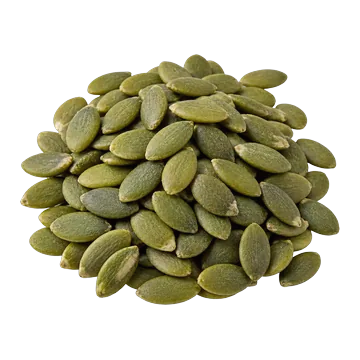 Pumpkin seeds150 mg in 30 g (this food: 105 mg) · but less selenium
Amounts as listed, not adjusted for how much gets in.
For selenium: no other snacks we’ve checked give clearly more, in the same 30 g.
None of the 18 other snacks we could compare gives clearly more nutrients per serving.
Your goal
Your goal changes only this list, not what the food gives you or what to watch.
Losing weight: fewer calories, and more nutrients, protein and fibre for each calorie.
- Pumpkin seeds
- More niacin (4.38 mg vs 0.76 mg)
- More magnesium (150 mg vs 105 mg)
- Less selenium (6.16 µg vs 84.1 µg)
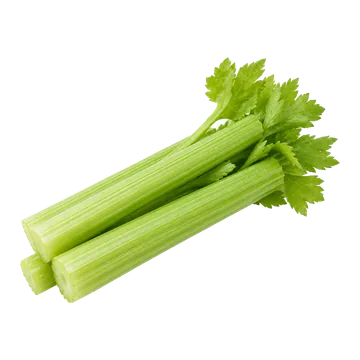 Celery, raw
- 4 kcal in 30 g (this food: 186)
- Less selenium (0 µg vs 84.1 µg)
- Less magnesium (3.28 mg vs 105 mg)
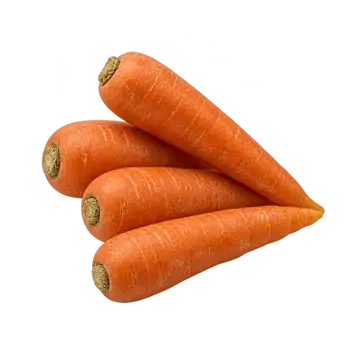 Carrots, raw
- 13 kcal in 30 g (this food: 186)
- Less selenium (0 µg vs 84.1 µg)
- Less magnesium (3.74 mg vs 105 mg)
None of the 22 other snacks we could compare gives clearly more protein, and more calories, per 100 g.
Bring a tracker export or describe your usual week. The same rules check all of it.
The numbers
Open every value
Name in the database: Brazil nuts, raw
How the serving was set: 30 g shelled (Health Canada TRA O.1, nuts and seeds not for use as snacks: whole, chopped, sliced, slivered or ground)
Listed nutrients, per 100 g
For each nutrient, the value this page uses is marked “used”. A row marked “second database” is another database’s figure for a matching food, kept so you can see how far databases disagree (they can differ in the samples analysed, lab methods and rounding). Its own cells are worked out from it, but none of the page’s words or scores are.
| Nutrient | Per serving | Per 100 calories | How | Source | Grade | |
|---|---|---|---|---|---|---|
| Omega-3: ALA | 0.036 g | 0.01 g | 0.01 g | listed used | Canadian Nutrient File 2026 #2544 | C |
| Calcium | 167.8 mg | 50.34 mg | 27.02 mg | listed used | US food database (USDA Foundation Foods) #2515373 | C |
| 170 mg | 51 mg | 27.38 mg | second database · not used | UK food tables (CoFID 2021) #14-871 | C | |
| 160 mg | 48 mg | 25.77 mg | copy of USDA · not used | Canadian Nutrient File 2026 #2544 | C | |
| Carbohydrate | 21.642 g | 6.49 g | 3.49 g | listed used | US food database (USDA Foundation Foods) #2515373 | C |
| Choline | 28.8 mg | 8.64 mg | 4.64 mg | listed used | Canadian Nutrient File 2026 #2544 | C |
| Omega-3: EPA + DHA | 0 g | 0 g | 0 g | listed used | UK food tables (CoFID 2021) #14-871 | C |
| Fat | 57.43 g | 17.23 g | 9.25 g | listed used | US food database (USDA Foundation Foods) #2515373 | C |
| 68.2 g | 20.46 g | 10.98 g | second database · not used | UK food tables (CoFID 2021) #14-871 | C | |
| Fibre | 5.984 g | 1.8 g | 0.96 g | listed used | US food database (USDA Foundation Foods) #2515373 | C |
| Iron | 2.474 mg | 0.74 mg | 0.4 mg | listed used | US food database (USDA Foundation Foods) #2515373 | C |
| 2.5 mg | 0.75 mg | 0.4 mg | second database · not used | UK food tables (CoFID 2021) #14-871 | C | |
| Magnesium | 351.3 mg | 105.39 mg | 56.57 mg | listed used | US food database (USDA Foundation Foods) #2515373 | C |
| 410 mg | 123 mg | 66.03 mg | second database · not used | UK food tables (CoFID 2021) #14-871 | C | |
| Niacin (B3, niacin equivalents) | 2.545 mg | 0.76 mg | 0.41 mg | listed used | Canadian Nutrient File 2026 #2544 | C |
| Phosphorus | 706.9 mg | 212.07 mg | 113.84 mg | listed used | US food database (USDA Foundation Foods) #2515373 | C |
| 590 mg | 177 mg | 95.02 mg | second database · not used | UK food tables (CoFID 2021) #14-871 | C | |
| Potassium | 592.5 mg | 177.75 mg | 95.42 mg | listed used | US food database (USDA Foundation Foods) #2515373 | C |
| 660 mg | 198 mg | 106.29 mg | second database · not used | UK food tables (CoFID 2021) #14-871 | C | |
| Protein | 15.037 g | 4.51 g | 2.42 g | listed used | US food database (USDA Foundation Foods) #2515373 | C |
| 14.3 g | 4.29 g | 2.3 g | second database · not used | UK food tables (CoFID 2021) #14-871 | C | |
| Selenium | 280.4 µg | 84.12 µg | 45.16 µg | listed used | US food database (USDA Foundation Foods) #2515373 | C |
| 254 µg | 76.2 µg | 40.91 µg | second database · not used | UK food tables (CoFID 2021) #14-871 | C | |
| Sodium | 0 mg | 0 mg | 0 mg | listed used | US food database (USDA Foundation Foods) #2515373 | C |
| 3 mg | 0.9 mg | 0.48 mg | second database · not used | UK food tables (CoFID 2021) #14-871 | C | |
| Vitamin D | 0 µg | 0 µg | 0 µg | listed used | UK food tables (CoFID 2021) #14-871 | C |
| Water | 2.265 g | 0.68 g | 0.36 g | listed used | US food database (USDA Foundation Foods) #2515373 | C |
| 2.8 g | 0.84 g | 0.45 g | second database · not used | UK food tables (CoFID 2021) #14-871 | C | |
| Zinc | 3.824 mg | 1.15 mg | 0.62 mg | listed used | US food database (USDA Foundation Foods) #2515373 | C |
| 4.2 mg | 1.26 mg | 0.68 mg | second database · not used | UK food tables (CoFID 2021) #14-871 | C | |
| Energy | 620.951 kcal | 186.29 kcal | – | FDC Energy (Atwater Specific Factors) used | US food database (USDA Foundation Foods) | – |
| Nutrient | Per 100 g | Per serving | Per 100 calories | How | Source | Grade |
|---|---|---|---|---|---|---|
| Copper | 1.739 mg | 0.52 mg | 0.28 mg | listed used | US food database (USDA Foundation Foods) #2515373 | C |
| 1.76 mg | 0.53 mg | 0.28 mg | second database · not used | UK food tables (CoFID 2021) #14-871 | C | |
| Energy (Atwater general) | 663.586 kcal | 199.08 kcal | 106.87 kcal | listed used | US food database (USDA Foundation Foods) #2515373 | C |
| Energy (Atwater specific) | 620.951 kcal | 186.29 kcal | 100 kcal | listed used | US food database (USDA Foundation Foods) #2515373 | C |
| Nitrogen | 2.754 g | 0.83 g | 0.44 g | listed used | US food database (USDA Foundation Foods) #2515373 | C |
| Ash | 3.626 g | 1.09 g | 0.58 g | listed used | US food database (USDA Foundation Foods) #2515373 | C |
| PUFA 18:3 | 0.036 g | 0.01 g | 0.01 g | listed used | Canadian Nutrient File 2026 #2544 | C |
| PUFA 22:6 n-3 (DHA) | 0 g | 0 g | 0 g | listed used | UK food tables (CoFID 2021) #14-871 | C |
| PUFA 20:5 n-3 (EPA) | 0 g | 0 g | 0 g | listed used | UK food tables (CoFID 2021) #14-871 | C |
| Manganese | 1.26 mg | 0.38 mg | 0.2 mg | listed used | US food database (USDA Foundation Foods) #2515373 | C |
| 1.2 mg | 0.36 mg | 0.19 mg | second database · not used | UK food tables (CoFID 2021) #14-871 | C |
Change the amount to rescale the first column. Nutrients a database doesn't list are missing, not zero.
Hazard rows as the dataset rates them
- Aflatoxins · Go easy: can double average intake · May exceed: no safe limit is set for aflatoxin B1; EFSA's 2020 reference point is a benchmark dose lower limit (BMDL10) of 0.4 µg/kg body weight/day. A daily 30 g serving adds 20.0 ng (lower bound) to 28.9 ng (upper bound), 0.286-0.413 ng/kg body weight/day at 70 kg. Against EFSA's adult mean exposure (lower bound 0.22-0.49, upper bound 1.35-3.25 ng/kg body weight/day) that is +58-130% on the lower-bound pairs and +13-31% on the upper-bound pairs, so the range reaches the doubling line. The mean in Brazil nuts is 0.6663 µg/kg (311 results, 25% quantified), the highest of the three nuts. · EFSA 2020 · A
- Aluminum · Nothing to watch: under the limit · No cap: EFSA's tolerable weekly intake for aluminium is 1 mg/kg body weight/week, 70,000 µg a week for 70 kg. Eaten alone, about 121,000 g of Brazil nuts a week would reach it. A 30 g serving every day comes to 121 µg a week, 0.2% of the limit. · CFIA chemical residue monitoring (2016–2023) · A
- Barium · Context · Context only: no Barium reference was opened (the paper cites a US EPA RfD of 0.2 mg/kg body weight/day = 14 mg a day at 70 kg; not read in the agency's own document, so recorded as missing here). 30 g contains 51.6 mg total barium, but only about 2% was bioaccessible in vitro (about 1 mg). · Barkleit 2025 · B
- Cadmium · Nothing to watch: under the limit · A daily serving adds 0.27% to an average adult's cadmium intake (EFSA 2012 adult median, 1.77 µg/kg body weight/week; Canadian adults in 2007: 1.2-1.75), far from doubling it, so no cap. · Bielecka 2021 · B
- Choking risk under age 4 · Worth knowing · Health Canada: nuts are not safe for children younger than four years. A Brazil nut is large and hard. · Health Canada, Nutrition for Healthy Term Infants: Recommendations… · A
- Lead · Nothing to watch: doesn’t double average intake · No cap: no safe limit is set for lead; EFSA's 2010 reference point is a benchmark dose lower limit (BMDL01) of 0.5 µg/kg body weight/day. Judged by what a serving adds to the average adult's intake of about 35 µg/day (EFSA 2012): 30 g at 82.11 µg/kg gives 2.5 µg, about 7%. That Polish retail mean (10 samples) is 20 to 25 times higher than CFIA import findings of 3.0-3.5 µg/kg, and the gap is not reconciled. · Bielecka 2021 · B
- Nickel · Nothing to watch: under the limit · No cap: EFSA's 2020 tolerable daily intake for nickel is 13 µg/kg body weight/day, 910 µg a day for 70 kg. Eaten alone, about 165 g of Brazil nuts a day would reach it (5.51 ppm, the highest CFIA annual mean). A 30 g serving is 165 µg, 18% of the limit, and adds 75% to the adult background median of 3.16 µg/kg body weight/day (221 µg/day), under the doubling line. · CFIA chemical residue monitoring (2016–2023) · A
- Nickel for people who are sensitised · Worth knowing · Flagged for people with nickel contact allergy: EFSA's 2020 lowest-observed-adverse-effect level for nickel-sensitised people is 4.3 µg Ni/kg body weight (301 µg at 70 kg). A 30 g serving carries 165 µg, 2.4 µg/kg body weight, a margin of 1.8 to that level; EFSA treats a margin of 30 or more as low concern. About 55 g would reach the level, and 1.8 g would give a margin of 30. · EFSA 2020 · A
- Oxalate for kidney-stone formers · Not rated yet · Not rated for calcium-oxalate stone formers: the only source is a patient-foundation list with no stated method (Oxalosis and Hyperoxaluria Foundation, Feb 2024), and no measured value was found. A 30 g serving carries 54.3 mg oxalate, a moderate portion by that list's own bands (25-99 mg). · Oxalosis and Hyperoxaluria Foundation 2024 · B
- Pesticide residues · Context · Context only (pesticide residues are not scored): one positive in 29 screens, none above a limit. · CFIA chemical residue monitoring (2016–2023) · A
- Radium · Context · Context only (not scored; no health-based Ra intake limit exists, the paper notes). Arithmetic with the paper's adult dose coefficients (2.8e-7 Sv/Bq 226Ra, 6.9e-7 Sv/Bq 228Ra): 30 g gives 0.43 + 0.99 = 1.4 µSv a day, about 0.52 mSv over a year of daily servings, against the 1 mSv/year public dose limit the paper cites; one 5 g nut a day is 0.09 mSv/year. A single batch. · Barkleit 2025 · B
- Salmonella · Context · Context only: no Brazil nut sample positive (the most sampled nut of the survey). · FSAI 2012 · B
- Selenium · Worth knowing · Flagged for selenium: the tolerable upper intake level from all sources is 255 µg/day for adults, including pregnancy and lactation (EFSA 2023; Health Canada 400 µg/day). A 30 g serving carries 84 µg on the USDA listing, 33% of EFSA's level, and about 91 g a day eaten alone would reach it; with EFSA's food-only adult background (mean 35.8-65.6 µg/day) a daily serving comes to 120-150 µg, under it. Selenium varies enormously between nuts: CFIA's import checks found annual means of 2.29 to 7.69 ppm (69 to 231 µg a serving) and one sample at 34 ppm, at which 7.5 g would reach the level. · US food database (USDA Foundation Foods) · C
- Tree nut allergy · Worth knowing · Brazil nuts are a Health Canada priority tree nut allergen: flagged for people with a tree nut allergy. · Health Canada, Tree Nuts - Priority food allergens · A
Oxalate, phytate and gut-tolerance measurements
- oxalate total: 181 mg/100 g · not stated (list gives 'avg oxalate per 100 g') · Brazil nuts, raw or roasted · grade B · Oxalosis and Hyperoxaluria Foundation 2024
- phytate: phytate (InsP6) (phytic acid) 831.7 mg/100 g; IP5 366.0, IP4 52.0, IP3 2.1 mg/100 g mg phytate (InsP6)/100 g edible portion · edible portion, raw (converted from micromoles/g with MW 660.04) · Brazil nuts, raw, no heat treatment (US) · grade B · Bennett 2025
Sources
- Barkleit A, Eum J, Walther D, et al. In Vitro Bioaccessibility and Speciation of Toxic and Nutritional Trace Elements in Brazil Nuts. Int J Mol Sci 2025;26(17):8312 · doi:10.3390/ijms26178312 · PMID 40943234
barkleit-2025-brazil-nuts· secondary source · CC BY 4.0 - Bennett G, Zhang L, Traka M (2025). Food & Nutrition NBRI Update to FAO/INFOODS Global Food Composition Database for Phytate (PhyFoodComp). Zenodo · doi:10.5281/zenodo.17658877
bennett-2025-phyfoodcomp· secondary source · CC BY-NC 4.0 - Bielecka J, Puscion-Jakubik A, Markiewicz-Zukowska R, et al. Assessment of the Safe Consumption of Nuts in Terms of the Content of Toxic Elements with Chemometric Analysis. Nutrients 2021;13(10):3606 · doi:10.3390/nu13103606 · PMID 34684607
bielecka-2021-nuts-toxic-elements· secondary source · CC BY 4.0 - CFIA, National Chemical Residue Monitoring Program, Annex B results summaries 2016-17 to 2022-23, Table B-1 domestic and B-2 imported (open.canada.ca datasets 95a14ca0, c87af563, a2ea8989, 9e5211c8, a5cb7c3c, 6567ac46, cf149850); positives-only means, no detection limits stated; pooled by us
cfia-ncrmp-annex-b-2016-2023· dataset · Government of Canada terms (Crown copyright) - Health Canada, Canadian Nutrient File 2026 (14th edition)
cnf-2026· dataset · Open Government Licence – Canada 2.0 - Public Health England, Composition of Foods Integrated Dataset (CoFID) 2021
cofid-2021· dataset · Open Government Licence v3.0 - EFSA (2020) Annexes to the risk assessment of aflatoxins in food, Annex B (occurrence tables), Zenodo · doi:10.5281/zenodo.3607186
efsa-2020-aflatoxins-annex· dataset · CC BY 4.0 - EFSA CONTAM Panel (2020). Update of the risk assessment of nickel in food and drinking water. EFSA Journal 18(11):6268 (PMC7643711) · doi:10.2903/j.efsa.2020.6268 · doi.org
efsa-2020-nickel· full text read · CC BY (EFSA Journal) - USDA FoodData Central, Foundation Foods, release 2026-04-30
fdc-foundation-2026-04-30· dataset · CC0 1.0 (public domain) - Food Safety Authority of Ireland, Bacteriological and Chemical Safety of Ready-to-Eat Dried Seeds and Ready-to-Eat Nuts (10NS1), August 2012
fsai-10ns1-2012· full text read · unknown - Health Canada, Nutrition for Healthy Term Infants: Recommendations from Six to 24 Months
hc-infant-nutrition-6-24-months· page · Government of Canada terms (Crown copyright; not OGL) - Health Canada, Tree Nuts - Priority food allergens
hc-tree-nuts-priority-allergens· page · Government of Canada terms (Crown copyright; not OGL) - Oxalosis and Hyperoxaluria Foundation. Oxalate list (022724), 2024
ohf-oxalate-list-2024· full text read · copyright OHF
Body map 2026-10-25.1: each nutrient’s job comes from an agency fact sheet, linked beside it under Good for.
The plain words: “a lot” means one serving (100 g when the food has no serving size) gives at least 20% of the daily amount (the reference intake), “some” at least 10%, “a little” at least 2% (the cut-offs are ours, one set for every page: 20% and 10% are borrowed from the US labelling terms “high” and “good source” and applied to Health Canada’s daily amount, whereas Health Canada’s own shopper rule says 15%; provisional: they may change in a later method version). The daily amount is Health Canada’s Dietary Reference Intake for adults 19–30; where men and women need different amounts we use the higher one (protein: 56 g for men, 46 g for women). The percentage printed under each nutrient is the printed amount as a share of that daily amount, rounded to the nearest whole number, and the word is read from that percentage, so the amount, the percentage and the word always agree. Calcium with a measured absorption is scaled by how well it gets in compared with milk.
The scale: “Nothing to watch” means a serving a day stays under the limit at ordinary amounts; “Go easy” means a serving a day can push past the limit for adults who already take in the most, or fewer than 2 servings reach it; “Limit it” means once a week or less. The dataset’s own rating is under “How we got this”. Provisional: the scale may change in a later method version.
Measured absorption under Good for: grade-A studies in adults that tested this preparation of this food, as a share of the listed amount (the share digested, for protein), quoted once each source has passed our evidence check; animal studies and other variants stay in the table above. Provisional: this screen may change in a later method version.