Radium
In the body: no agency opinion we hold names an effect at the amounts found in food, so it is shown for context, not rated.
Not rated by dose: a flag on one reviewed food, Brazil nuts, raw.
Background. Shown, not scored: no dose basis at normal intake, a classification rather than a risk, or legal limits only.
The reference value and where it comes from
- The agency’s figureno agency dose value
- Basisno health-based intake limit exists for radium (radioactivity); the paper cites the general public dose limit of 1 mSv/year and adult effective dose coefficients 2.8e-7 Sv/Bq (226Ra) and 6.9e-7 Sv/Bq (228Ra)
- Source ?Barkleit 2025
Reviewed foods that carry it
1 reviewed food carries it; none is rated by dose.
How often you can eat it ?
No food here is rated by dose. Each line says why it’s listed: a flag for the people the source names, advice on handling it, or context.
Flags and context, not rated by dose
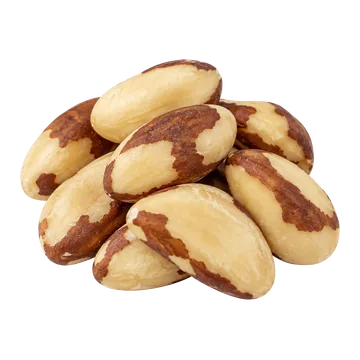 Brazil nuts, raw
Context
1.55per servingBq 226Ra (plus 1.43 Bq 228Ra)Barkleit 2025 · grade B ?
How it’s rated
Context only (not scored; no health-based Ra intake limit exists, the paper notes). Arithmetic with the paper's adult dose coefficients (2.8e-7 Sv/Bq 226Ra, 6.9e-7 Sv/Bq 228Ra): 30 g gives 0.43 + 0.99 = 1.4 µSv a day, about 0.52 mSv over a year of daily servings, against the 1 mSv/year public dose limit the paper cites; one 5 g nut a day is 0.09 mSv/year. A single batch.
Intake: 30 g shelled serving, daily · Level in the food: 51.6 mBq/g (226Ra specific activity, whole nuts, mean ± standard deviation 51.6 ± 3.7 (literature 17-205); 228Ra 47.7 ± 3.0 (literature 18-100), n = 1)
Measured on: Barkleit 2025: one commercial batch of whole Brazil nuts (n not stated; ± is the measurement standard deviation), gamma spectrometry; Germany
Sources
- Barkleit A, Eum J, Walther D, et al. In Vitro Bioaccessibility and Speciation of Toxic and Nutritional Trace Elements in Brazil Nuts. Int J Mol Sci 2025;26(17):8312 · doi:10.3390/ijms26178312 · PMID 40943234
barkleit-2025-brazil-nuts· secondary source · CC BY 4.0