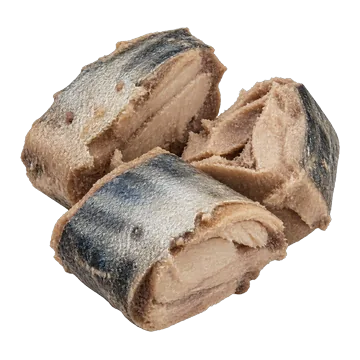
Mackerel, canned
Checked by us One serving: 55 g
Weighed drained, without the liquid in the can.
Too little nutrient data to say what it’s good for.
Worth knowing: dioxins and dioxin-like PCBs.
Good for
How we counted this
What one serving (55 g) gives you.
Too few nutrient values to say. Missing nutrients are left out, not counted as zero.
Watch out
How we counted this
Dioxins and dioxin-like PCBs
Worth knowingAn average adult is already at or past the limit from other food.
Learn more
Flagged for women who are or may become pregnant and for breastfeeding; no cap for other adults. The CFIA 2014-2019 figures are for "Mackerel" (11 samples, species and form not given), so this is a life-stage flag, not an Atlantic-mackerel rating. A daily serving is 88% of EFSA's 2026 tolerable weekly intake (0.6 pg/kg body weight/week) on the lower-bound mean and 169% on the upper; one serving a week 13-24%. The one Canadian sample (26.4% fat, probably Atlantic) gives 27-139% a day. One Chinese sample (upper bound 0.51 pg/g) drives the mean.
Methylmercury
Nothing to watchYou’d need about 11 servings a day, every day, of this food alone to use up what an average adult’s intake leaves under the limit.
Learn more
One serving carries 0.99 µg (total Hg)
How we got this
An average adult already takes in about 18% of the limit. One serving a day fits in the room left.
Counted from zero, with no allowance for what adults already take in from other food, 5,100 g a week would reach the limit.
Why this rating: Eating it daily comes to 385 g a week, which stays within the 4,100 g of room left before the limit.
Women who are or may become pregnant, and children: 780 g a day.
The dataset’s rating: Nothing to watch: under the limit
No cap, on agency advice for this fish: Health Canada names Atlantic mackerel among fish 'very low' in mercury and sets no limit for it, and the FDA and EPA list it as a Best Choice. For information, a daily serving is 8% of EFSA's tolerable weekly intake of 1.3 µg/kg body weight/week (2-13% across lower and upper bounds); one serving a week is 1.1%. King mackerel is a different fish with its own mercury (CFIA edible mean 0.268 ppm, 7 of 54 samples above Health Canada's 0.5 ppm standard; FDA mean 0.730): not this food.
CFIA, Mercury and Metals in Fish Products 2000-2021 (tuna rows: 7,072; canned 2,388) · grade B
Inorganic arsenic
Nothing to watchYou’d need about 7 servings a day, every day, of this food alone to double the inorganic arsenic an average adult already gets. No dose is known to be safe, so doubling is where we flag.
Learn more
A serving a day adds 3.1–16% to what an average adult already takes in. There is no limit to take a share of.
One serving carries 0.33 µg (upper bound)
How we got this
The dataset’s rating: Nothing to watch: doesn’t double average intake
At the bound: 0.0047 µg/kg body weight/day = 8% of the EFSA benchmark dose lower limit (BMDL05) 0.06 µg/kg body weight/day, adding 3-16% to the adult background 0.03-0.15 (EFSA 2021, as held in the seeds); below the doubling line even at the bound. Total arsenic in CFIA Atlantic mackerel muscle is 1.23 mg/kg (n = 5), not rated: 68 µg total As per serving.
Checked for histamine, cadmium and lead: fine at normal amounts.
Histamine
Nothing to watchYou’d need about 65 servings in one meal of this food alone to reach the limit.
Learn more
One serving carries 0.77 mg (at 14 mg/kg)
How we got this
3,600 g in one meal reaches the limit
The dataset’s rating: Nothing to watch: under the limit
Polish positives: at most 0.77 mg per 55 g = 1.5% of 50 mg. The Serbian worst subsample (412 mg/kg) = 22.7 mg per 55 g = 45% of 50 mg; 2 of 13 lots failed the EC criterion (m 100, M 200 mg/kg). Canning keeps whatever histamine the raw fish had. No cap for healthy adults; person-specific flag as for the raw row.
Cadmium
Nothing to watchYou’d need about 13 servings a day, every day, of this food alone to use up what an average adult’s intake leaves under the limit.
Learn more
One serving carries 0.55 µg
How we got this
A serving a day adds 3.1% to what an average adult already takes in: a share of that intake, not of the limit. With that serving every day, an average adult would be at about 73% of the limit.
An average adult already takes in about 71% of the limit. One serving a day fits in the room left.
Counted from zero, with no allowance for what adults already take in from other food, 18,000 g a week would reach the limit.
Why this rating: Eating it daily comes to 385 g a week, which stays within the 5,100 g of room left before the limit.
The dataset’s rating: Nothing to watch: under the limit
A daily serving adds 3.1% to an average adult's cadmium intake (EFSA 2012 adult median, 1.77 µg/kg body weight/week; Canadian adults in 2007: 1.2-1.75), far from doubling it, so no cap.
CFIA, Mercury and Metals in Fish Products 2000-2021 (tuna rows: 7,072; canned 2,388) · grade B
Lead
Nothing to watchYou’d need about 64 servings a day, every day, of this food alone to double the lead an average adult already gets. No dose is known to be safe, so doubling is where we flag.
Learn more
A serving a day adds 1.6% to what an average adult already takes in. There is no limit to take a share of.
One serving carries 0.55 µg
How we got this
The dataset’s rating: Nothing to watch: doesn’t double average intake
Adds 1.57-1.57% (lower bound-upper bound) to the average adult intake of 35 µg/day (EFSA, 0.50 µg/kg body weight/day at 70 kg). No safe threshold exists (benchmark dose lower limit (BMDL01) is the level of concern); far below the doubling line.
CFIA, Mercury and Metals in Fish Products 2000-2021 (tuna rows: 7,072; canned 2,388) · grade B
For some people
Measured, not rated: 67.2 mg purines (taken from a similar food)
Learn more
If you have gout: avoiding organ meats such as liver, which are higher in purines, is one of the diet changes that help lower uric acid in the blood and the number of flares, according to the US National Institutes of Health (NIH).
Source: NIAMS (NIH), Gout: diagnosis, treatment, and steps to take
How we got this
Not rated for people with gout or hyperuricemia: the only reference is a Japanese dietary recommendation of 400 mg purines a day, seen through Kaneko 2014 rather than an agency document, so no reference is established. Kaneko 2014 has no Atlantic or canned mackerel; its raw chub mackerel measures 122.1 mg purines per 100 g (HPLC, four purine bases), beside jack mackerel 165.3 and Spanish mackerel 139.3, and stands in. A 55 g serving carries about 67 mg. For scale only, 400 mg would be reached at about 328 g.
Better options
How we counted this
“Better” here always means better at something the row names: more of one nutrient, more nutrients per serving, or the goal you pick. It never means better in every way.
Every amount below is for the same weight, 55 g, the size of one serving of this food, so a swap compares like with like. A serving of another food can be bigger or smaller.
Not enough nutrient values for this food to compare it.
Your goal
Your goal changes only this list, not what the food gives you or what to watch.
Not enough nutrient values for this food to compare it.
Not enough nutrient values for this food to compare it.
Bring a tracker export or describe your usual week. The same rules check all of it.
The numbers
Open every value
Name in the database: Mackerel, Atlantic, canned, drained
How the serving was set: fraction can (55 g) (Health Canada TRA I.4, canned; footnote 2 excludes packing liquid unless customarily consumed)
Listed nutrients, per 100 g
For each nutrient, the value this page uses is marked “used”. A row marked “second database” is another database’s figure for a matching food, kept so you can see how far databases disagree (they can differ in the samples analysed, lab methods and rounding). Its own cells are worked out from it, but none of the page’s words or scores are.
| Nutrient | Per serving | How | Source | Grade |
|---|
Change the amount to rescale the first column. Nutrients a database doesn't list are missing, not zero.
Hazard rows as the dataset rates them
- Cadmium · Nothing to watch: under the limit · A daily serving adds 3.1% to an average adult's cadmium intake (EFSA 2012 adult median, 1.77 µg/kg body weight/week; Canadian adults in 2007: 1.2-1.75), far from doubling it, so no cap. · CFIA mercury and metals in fish (2000–2021) · B
- Dioxins and dioxin-like PCBs · Worth knowing · Flagged for women who are or may become pregnant and for breastfeeding; no cap for other adults. The CFIA 2014-2019 figures are for "Mackerel" (11 samples, species and form not given), so this is a life-stage flag, not an Atlantic-mackerel rating. A daily serving is 88% of EFSA's 2026 tolerable weekly intake (0.6 pg/kg body weight/week) on the lower-bound mean and 169% on the upper; one serving a week 13-24%. The one Canadian sample (26.4% fat, probably Atlantic) gives 27-139% a day. One Chinese sample (upper bound 0.51 pg/g) drives the mean. · CFIA dioxins survey (2014–2019) · B
- Fish allergy · Worth knowing · Person-specific (fish allergy); the Health Canada list of priority allergens includes Fish. Cooking or canning does not remove it (general fact, not sourced here). · Health Canada, priority allergens · A
- Histamine · Nothing to watch: under the limit · Polish positives: at most 0.77 mg per 55 g = 1.5% of 50 mg. The Serbian worst subsample (412 mg/kg) = 22.7 mg per 55 g = 45% of 50 mg; 2 of 13 lots failed the EC criterion (m 100, M 200 mg/kg). Canning keeps whatever histamine the raw fish had. No cap for healthy adults; person-specific flag as for the raw row. · PubMed 35112003 · A
- Inorganic arsenic · Nothing to watch: doesn’t double average intake · At the bound: 0.0047 µg/kg body weight/day = 8% of the EFSA benchmark dose lower limit (BMDL05) 0.06 µg/kg body weight/day, adding 3-16% to the adult background 0.03-0.15 (EFSA 2021, as held in the seeds); below the doubling line even at the bound. Total arsenic in CFIA Atlantic mackerel muscle is 1.23 mg/kg (n = 5), not rated: 68 µg total As per serving. · Julshamn 2012 · B
- Lead · Nothing to watch: doesn’t double average intake · Adds 1.57-1.57% (lower bound-upper bound) to the average adult intake of 35 µg/day (EFSA, 0.50 µg/kg body weight/day at 70 kg). No safe threshold exists (benchmark dose lower limit (BMDL01) is the level of concern); far below the doubling line. · CFIA mercury and metals in fish (2000–2021) · B
- Methylmercury · Nothing to watch: under the limit · No cap, on agency advice for this fish: Health Canada names Atlantic mackerel among fish 'very low' in mercury and sets no limit for it, and the FDA and EPA list it as a Best Choice. For information, a daily serving is 8% of EFSA's tolerable weekly intake of 1.3 µg/kg body weight/week (2-13% across lower and upper bounds); one serving a week is 1.1%. King mackerel is a different fish with its own mercury (CFIA edible mean 0.268 ppm, 7 of 54 samples above Health Canada's 0.5 ppm standard; FDA mean 0.730): not this food. · CFIA mercury and metals in fish (2000–2021) · B
- Purines and gout · Not rated yet · Not rated for people with gout or hyperuricemia: the only reference is a Japanese dietary recommendation of 400 mg purines a day, seen through Kaneko 2014 rather than an agency document, so no reference is established. Kaneko 2014 has no Atlantic or canned mackerel; its raw chub mackerel measures 122.1 mg purines per 100 g (HPLC, four purine bases), beside jack mackerel 165.3 and Spanish mackerel 139.3, and stands in. A 55 g serving carries about 67 mg. For scale only, 400 mg would be reached at about 328 g. · Kaneko 2014 · C
Oxalate, phytate and gut-tolerance measurements
- histamine: 3 of 9 positive, positives 3.4-14.0; 6 of 9 below the detection limit 2.1 mg/kg · fresh weight · canned, Polish market · grade A · PubMed 35112003
- histamine: 13 production lots (9 subsamples each): compliant-lot mean 3.34 (standard deviation 3.5), median 2.5, max 26; all-lots mean 26.45 (standard deviation 77.2), median 2.5, max 412; 2 of 13 lots (15.38%) non-compliant to EC 2073/2005 mg/kg · fresh weight (values below LoQ entered as 2.5 mg/kg) · canned, imported, Serbian retail 2018 · grade B · Simunovic 2019
Sources
- CFIA, Food Safety Action Plan Targeted Survey: Dioxins and Dioxin-like Compounds in Selected Foods 2014-2019 (data and 2-page overview PDF; report page inspection.canada.ca)
cfia-dioxins-2014-2019· dataset · Open Government Licence – Canada 2.0 - CFIA, Mercury and Metals in Fish Products 2000-2021 (tuna rows: 7,072; canned 2,388)
cfia-fish-metals-2000-2021· dataset · Open Government Licence – Canada 2.0 - Health Canada, Common food allergens (priority allergens list)
hc-priority-allergens· page · Government of Canada terms (Crown copyright; not OGL) - Julshamn K, Nilsen BM, Frantzen S, Valdersnes S, Maage A, Nedreaas K, Sloth JJ. Total and inorganic arsenic in fish samples from Norwegian waters. Food Addit Contam B 2012 · doi:10.1080/19393210.2012.698312 · PMID 24786400
julshamn2012· abstract only · not checked - Kaneko K, et al. (2014) Total purine and purine base content of common foodstuffs for facilitating nutritional therapy for gout and hyperuricemia. Biol Pharm Bull 37(5):709-721 · doi:10.1248/bpb.b13-00967 · PMID 24553148
kaneko-2014-purines· secondary source · J-STAGE open access - Pawul-Gruba M, Osek J. Identification of Histamine in Fish and Fish Products in Poland During 2014-2018. J Vet Res 2021;65(4):483-486 · doi:10.2478/jvetres-2021-0066 · PMID 35112003
pmid:35112003· full text read · CC BY-NC-ND 3.0 - Simunovic S, Jankovic S, Baltic T, Nikolic D, Djinovic-Stojanovic J, Lukic M, Parunovic N. Histamine in canned and smoked fishery products sold in Serbia. Meat Technology 2019;60(1):8-16. · doi:10.18485/meattech.2019.60.1.2
simunovic2019· full text read · open access (journal site)
Body map 2026-10-25.1: each nutrient’s job comes from an agency fact sheet, linked beside it under Good for.
The plain words: “a lot” means one serving (100 g when the food has no serving size) gives at least 20% of the daily amount (the reference intake), “some” at least 10%, “a little” at least 2% (the cut-offs are ours, one set for every page: 20% and 10% are borrowed from the US labelling terms “high” and “good source” and applied to Health Canada’s daily amount, whereas Health Canada’s own shopper rule says 15%; provisional: they may change in a later method version). The daily amount is Health Canada’s Dietary Reference Intake for adults 19–30; where men and women need different amounts we use the higher one (protein: 56 g for men, 46 g for women). The percentage printed under each nutrient is the printed amount as a share of that daily amount, rounded to the nearest whole number, and the word is read from that percentage, so the amount, the percentage and the word always agree. Calcium with a measured absorption is scaled by how well it gets in compared with milk.
The scale: “Nothing to watch” means a serving a day stays under the limit at ordinary amounts; “Go easy” means a serving a day can push past the limit for adults who already take in the most, or fewer than 2 servings reach it; “Limit it” means once a week or less. The dataset’s own rating is under “How we got this”. Provisional: the scale may change in a later method version.
Measured absorption under Good for: grade-A studies in adults that tested this preparation of this food, as a share of the listed amount (the share digested, for protein), quoted once each source has passed our evidence check; animal studies and other variants stay in the table above. Provisional: this screen may change in a later method version.