Trans fats
In the body: Trans fats raise “bad” LDL cholesterol and lower “good” HDL, which raises the risk of heart disease.
Not rated by dose: a flag on 5 reviewed foods, among them Coconut oil, Coffee creamer, flavoured liquid and Mayonnaise. The list below has a line for each of 9 preparations.
Background. Shown, not scored: no dose basis at normal intake, a classification rather than a risk, or legal limits only.
A reference figure, shown for context
A background hazard, shown for scale: no food on this page is rated against this figure.
- The agency’s figure1 % of total energy
- Basisa dietary goal for whole diets, not a toxic limit
upper intake: no more than 1% of total energy from trans-fatty acids, industrial and ruminant (WHO 2023); Health Canada's public-health objective is intake below 1% of total energy (intake guideline (not a toxicological reference point)) - Average adult intake no agency mean given in the documents opened
- Applies tototal intake, all sources
- Source ?WHO 2023
Reviewed foods that carry it
5 reviewed foods carry it; none is rated by dose. A food counts once, as in the foods list: preparations sharing a page (raw and cooked, canned) count once; one with its own page counts apart. Below, one line for each of 9 preparations.
How often you can eat it ?
No food here is rated by dose. Each line says why it’s listed: a flag for the people the source names, advice on handling it, or context.
Flags and context, not rated by dose
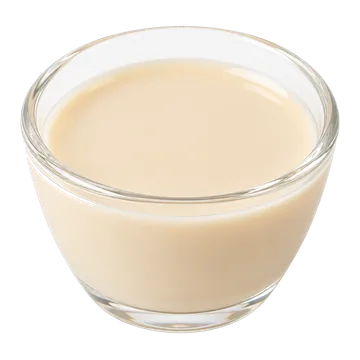 Coffee creamer, flavoured liquid
Not rated yet
How it’s rated
Not rated: no measured trans-fat value for a current Canadian creamer was found. Arcand et al. 2014 (abstract only) found 66.7% of coffee whiteners in Canadian databases analysed in 2005-2011 among the categories with many products over the voluntary limits. Canada has since prohibited partially hydrogenated oils (2017 notice), so that finding is historical. A US powder figure of 5.541 g/100 g would be 0.11 g in a 2.0 g serving.
Intake: one 15.2 g (15 mL) serving a day, 70 kg adult
Measured on: Hydrogenated vegetable oil in non-dairy creamers (SR 171261 formulation). SR 171261 and the plan's 173453 list NO trans fat; the powder record SR 171263 lists 5.541 g/100 g (calculated, pre-ban US).
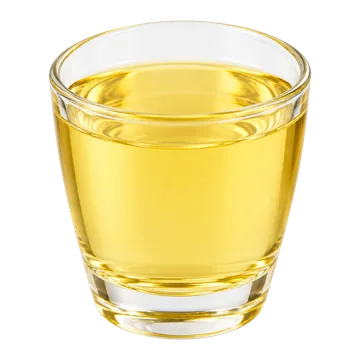 Canola oil
Context
0.036 gper servingUS food database (USDA SR Legacy) · grade C ?
This amount varies a lot from one batch to the next: the figures we hold for this food differ twofold or more. Every figure on this site uses the same one, the food’s listed value.
How it’s rated
Shown as context, not rated: WHO (2023) advises no more than 1% of total energy from trans fat, and Health Canada's public-health objective is less than 1%; on a 2,000 kcal diet that is 2.22 g a day. A serving carries 0.036 g, 1.6% of it. This is the trans fat formed when oil is refined, not from partially hydrogenated oil; Health Canada's 2017 notice puts non-hydrogenated refined oils at generally less than 2% of the oil.
Intake: one 9.21 g (10 mL) serving a day, 70 kg adult · Level in the food: 0.395 g/100 g (listed value)
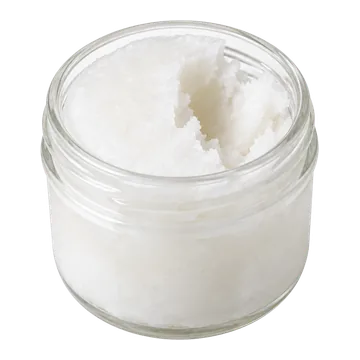 Coconut oil
Context
0.0028 gper servingUS food database (USDA SR Legacy) · grade C ?
How it’s rated
Context (WHO: under 1% of energy, 2.22 g on 2,000 kcal): 0.003 g is 0.1% of it.
Intake: one 10.0 g serving a day, 70 kg adult · Level in the food: 0.028 g/100 g (listed value)
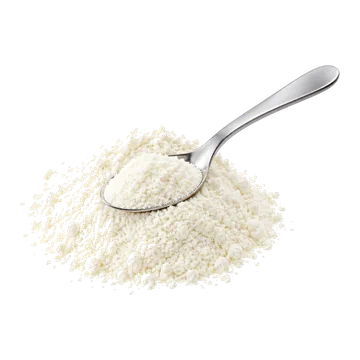 Coffee creamer, powder
Context
0.111 gper servingUS food database (USDA SR Legacy) · grade C ?
How it’s rated
Shown as context, not rated: a 2.0 g serving of powder carries 0.11 g of trans fat, 5% of the 2.2 g a day implied by WHO's ceiling of 1% of energy at 2,000 kcal; three servings a day would be 15%. This is a US value from before the ban (5.541 g/100 g); a Canadian creamer made since September 2018 should not contain partially hydrogenated oil, so this is a historical bound.
Intake: one 2.0 g serving a day, 70 kg adult · Level in the food: 5.541 g/100 g (listed value)
- Corn oil
Context
0.041 gper servingtrans fatCanadian Nutrient File 2026 · grade B ?
How it’s rated
Shown as context, not rated: WHO (2023) advises no more than 1% of total energy from trans fat, and Health Canada's public-health objective is less than 1%; on a 2,000 kcal diet that is 2.22 g a day. A serving carries 0.041 g, 1.9% of it. This is the trans fat formed when oil is refined, not from partially hydrogenated oil; Health Canada's 2017 notice puts non-hydrogenated refined oils at generally less than 2% of the oil.
Intake: one 9.21 g (10 mL) serving a day, 70 kg adult · Level in the food: 0.449 g/100 g (database value (listing))
Measured on: CNF 437 'Vegetable oil, corn': fatty acids, trans, total 0.4493 g/100 g (USDA SR 171029 lists TFA 18:1 t 0, 1 data point). Deodorisation of refined oil; not partially hydrogenated oil.
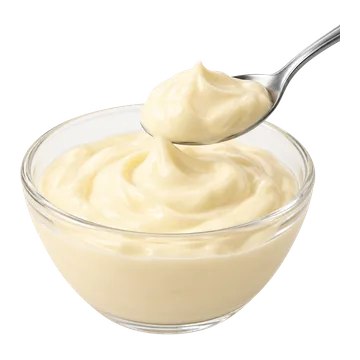 Mayonnaise
Context
0.03 gper servingUS food database (USDA Foundation Foods) · grade C ?
This amount varies a lot from one batch to the next: the figures we hold for this food differ twofold or more. Every figure on this site uses the same one, the food’s listed value.
How it’s rated
Shown as context, not rated: WHO's ceiling for trans fat is no more than 1% of energy, 2.2 g a day on 2,000 kcal. A serving carries 0.03 g, 1.3% of that ceiling. The figure is a US database value, not a Canadian measurement.
Intake: one 13.95 g (15 mL) serving a day, 70 kg adult · Level in the food: 0.213 g/100 g (listed value, n = 8)
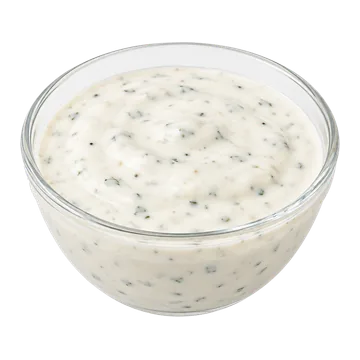 Ranch dressing
Context
0.052 gper servingUS food database (USDA Foundation Foods) · grade C ?
How it’s rated
Shown as context, not rated: a serving carries 0.05 g of trans fat, 2.4% of the WHO ceiling of 1% of energy (2.2 g of a 2,000 kcal day). This is a USDA database value for a US product (8 data points); industrial hydrogenation has been prohibited in Canada since September 2018. Ranch also carries buttermilk, so some of this is ruminant trans fat, which the database does not separate.
Intake: one 30.4 g (30 mL) serving a day, 70 kg adult · Level in the food: 0.172 g/100 g (listed value, n = 8)
- Soybean oil
Context
0.049 gper servingUS food database (USDA SR Legacy) · grade C ?
This amount varies a lot from one batch to the next: the figures we hold for this food differ twofold or more. Every figure on this site uses the same one, the food’s listed value.
How it’s rated
Shown as context, not rated: WHO (2023) advises no more than 1% of total energy from trans fat, and Health Canada's public-health objective is less than 1%; on a 2,000 kcal diet that is 2.22 g a day. A serving carries 0.049 g, 2.2% of it. This is the trans fat formed when oil is refined, not from partially hydrogenated oil; Health Canada's 2017 notice puts non-hydrogenated refined oils at generally less than 2% of the oil. Brazilian retail refined soybean oils averaged 1.84 g/100 g, because the refining step varies by producer.
Intake: one 9.21 g (10 mL) serving a day, 70 kg adult · Level in the food: 0.533 g/100 g (listed value)
- Sunflower oil
Context
0.011 gper servingUS food database (USDA Foundation Foods) · grade C ?
This amount varies a lot from one batch to the next: the figures we hold for this food differ twofold or more. Every figure on this site uses the same one, the food’s listed value.
How it’s rated
Shown as context, not rated: WHO (2023) advises no more than 1% of total energy from trans fat, and Health Canada's public-health objective is less than 1%; on a 2,000 kcal diet that is 2.22 g a day. A serving carries 0.011 g, 0.5% of it. This is the trans fat formed when oil is refined, not from partially hydrogenated oil; Health Canada's 2017 notice puts non-hydrogenated refined oils at generally less than 2% of the oil.
Intake: one 9.21 g (10 mL) serving a day, 70 kg adult · Level in the food: 0.116 g/100 g (listed value, n = 8)
Sources
- Health Canada, Canadian Nutrient File 2026 (14th edition)
cnf-2026· dataset · Open Government Licence – Canada 2.0 - USDA FoodData Central, Foundation Foods, release 2026-04-30
fdc-foundation-2026-04-30· dataset · CC0 1.0 (public domain) - USDA FoodData Central, SR Legacy, 2018-04
fdc-sr-legacy-2018-04· dataset · CC0 1.0 (public domain) - Arcand J, Scourboutakos MJ, Au JT, L'Abbe MR. trans Fatty acids in the Canadian food supply: an updated analysis. Am J Clin Nutr 2014 · doi:10.3945/ajcn.114.088732 · PMID 25099549
pmid:25099549· abstract only · licence not recorded - WHO. WHO updates guidelines on fats and carbohydrates (news, 17 July 2023), summarising the guideline on saturated and trans-fatty acid intake
who-sfa-tfa-2023· full text read · licence not recorded