Potato glycoalkaloids (solanine)
In the body: A big dose in one meal upsets the stomach.
The one to watch: baked potatoes. About 140 g, eaten alone, reaches the one-sitting limit. Also boiled potatoes, at about 140 g on the same count. The rest stay under it at a serving a day. The one with the least room, French fries, frozen, oven-baked, has about 320 g, eaten alone.
Too much in one go. Harm from one big portion. A food measured against the agency’s dose shows the grams that reach it in one sitting.
The working limit, from an effect level
The agency gives the lowest dose that caused an effect in studies, 1 mg total glycoalkaloids/kg body weight: not a limit. It counts a margin of exposure under 10 as a concern, so the grams below are counted against that dose divided by 10: 0.1 mg total glycoalkaloids/kg body weight, or 7 mg for a 70 kg adult.
- The agency’s figure1 mg total glycoalkaloids/kg body weight
- Basislowest dose with an observed effect (LOAEL), not a limit
lowest-observed-adverse-effect level (LOAEL) (acute gastrointestinal effects) (human lowest-observed-adverse-effect level (LOAEL)) - Margin of exposure that raises concern ?10
A margin below this counts as a concern. A margin of exposure is the dose that caused effects in studies divided by what people take in: the smaller it is, the closer people’s intake sits to that dose. - Source ?EFSA 2020
Reviewed foods that carry it
2 reviewed foods carry it, 2 of them rated by dose. A food counts once, as in the foods list: preparations sharing a page (raw and cooked, canned) count once; one with its own page counts apart. Below, one line for each of 4 preparations. 4 of those lines are rated by dose.
Grams to the limit ?
Grams of each food that reach the limit in its window, for a 70 kg adult. Fewest first: those are the foods to watch.
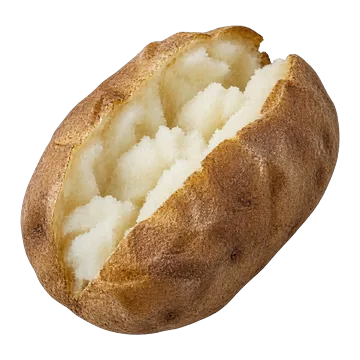 Potato, baked
Go easy: within 2 servings of the limit for a 110 g serving
140greaches the limit in one sittingCounted from zero: this food eaten alone.5.6 mg per 110 g servingHow it’s rated
Rated on the dose in one meal, at the mean: no cap. EFSA's lowest effect level is 1 mg total glycoalkaloids/kg body weight, and a margin of exposure above 10 means no concern, so the limit is 0.1 mg/kg body weight, 7 mg for 70 kg. A 110 g serving at the mean (51.2 mg/kg) carries 5.6 mg, 0.080 mg/kg body weight: a margin of 12.4, 80% of the limit. Potatoes with more go past it: at the 95th percentile (116.8 mg/kg) a serving is 12.8 mg, margin 5.4; at the highest sample (276.6) 30.4 mg, margin 2.3. One 110 g serving reaches the limit at 64 mg/kg. How potatoes are stored and trimmed decides the level: remove green parts. Baked and eaten with skin: EFSA's literature range for oven-baking unpeeled potatoes is a 20-50% cut in total glycoalkaloids (3-45% for microwaving). EFSA reports far higher concentrations in peel than flesh (e.g. 150-8,133 mg/kg dry weight in peel vs 4-957 in flesh, Valcarcel 2014 as cited), so a whole baked potato eaten with skin is the higher-dose case; EFSA gives no share-of-total figure.
Intake: one 110 g serving a day (taken at the raw-tuber concentration, no peeling or cooking factor applied; whether the 110 g is raw or cooked weight is unresolved), 70 kg adult · Level in the food: 51.2 mg/kg (mean, n = 604)
Measured on: food-specific but RAW: EFSA 2020 main-crop plus new potatoes, unpeeled, 604 samples (DE 432, NL 133, SE 39; 2005–2017); P95 116.8, max 276.6 mg/kg
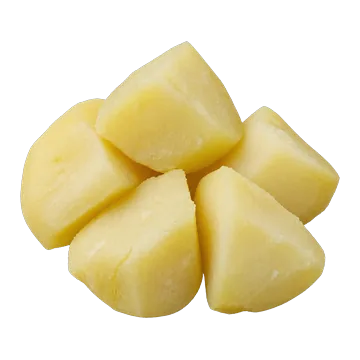 Potato, boiled
Go easy: within 2 servings of the limit for a 110 g serving
140greaches the limit in one sittingCounted from zero: this food eaten alone.5.6 mg per 110 g servingHow it’s rated
Rated on the dose in one meal, at the mean: no cap. EFSA's lowest effect level is 1 mg total glycoalkaloids/kg body weight, and a margin of exposure above 10 means no concern, so the limit is 0.1 mg/kg body weight, 7 mg for 70 kg. A 110 g serving at the mean (51.2 mg/kg) carries 5.6 mg, 0.080 mg/kg body weight: a margin of 12.4, 80% of the limit. Potatoes with more go past it: at the 95th percentile (116.8 mg/kg) a serving is 12.8 mg, margin 5.4; at the highest sample (276.6) 30.4 mg, margin 2.3. One 110 g serving reaches the limit at 64 mg/kg. How potatoes are stored and trimmed decides the level: remove green parts. Peeled then boiled: EFSA's literature gives peeling a 25-75% cut (average 48%) and boiling 5-65% (average 33%). EFSA's exposure model used peeling factors of 0.25-0.75 and cooking factors of 0.35-0.95.
Intake: one 110 g serving a day (taken at the raw-tuber concentration, no peeling or cooking factor applied; whether the 110 g is raw or cooked weight is unresolved), 70 kg adult · Level in the food: 51.2 mg/kg (mean, n = 604)
Measured on: food-specific but RAW: EFSA 2020 main-crop plus new potatoes, unpeeled, 604 samples (DE 432, NL 133, SE 39; 2005–2017); P95 116.8, max 276.6 mg/kg
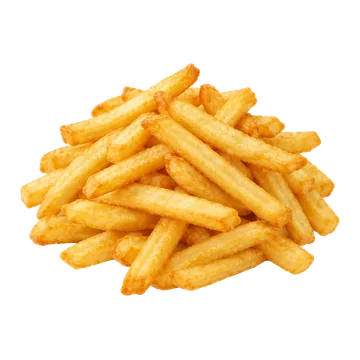 French fries, frozen, oven-baked
Nothing to watch: under the limit for a 70 g serving
320greaches the limit in one sittingCounted from zero: this food eaten alone.1.54 mg per 70 g servingHow it’s rated
No cap: these are frozen fries as sold, before baking, which drives off water, so the baked concentration is higher. EFSA's 2020 no-concern line for one sitting is 100 µg/kg body weight of total glycoalkaloids (7,000 µg at 70 kg; an effect level of 1 mg/kg body weight with a margin of 10). At the mean of 22 µg/g, 318 g in one sitting would reach it, eaten alone; a 70 g serving is 22% of the limit, and 58% at the highest value reported (58 mg/kg). This is a fried or processed product, not the raw tuber.
Intake: one 70 g serving a day (Health Canada TRA P.1), 70 kg adult · Level in the food: 22 mg/kg (mean, n = 18)
Measured on: Bushway and Ponnampalam 1981 (USA) as compiled in EFSA 2020 Table 34: 'Frozen fries (steak, French, crinkle cut)', 18 commercial products, HPLC-UV, mg/kg fresh weight, range 3.3-58
- French fries, restaurant
Nothing to watch: under the limit for a 70 g serving
390greaches the limit in one sittingCounted from zero: this food eaten alone.1.26 mg per 70 g servingHow it’s rated
No cap: EFSA's 2020 no-concern line for one sitting is 100 µg/kg body weight of total glycoalkaloids (7,000 µg at 70 kg; an effect level of 1 mg/kg body weight with a margin of 10). At the mean of 18 µg/g, 389 g in one sitting would reach it, eaten alone; a 70 g serving is 18% of the limit, and 44% at the highest value reported (44 mg/kg, 159 g). The source says only "commercial product" for three samples and does not say where the fries were bought. This is a fried or processed product, not the raw tuber.
Intake: one 70 g serving a day (Health Canada TRA P.1), 70 kg adult · Level in the food: 18 mg/kg (mean, n = 3)
Measured on: Friedman and Dao 1992 (USA) as compiled in EFSA 2020 Table 34: 'French fries', 3 commercial samples, HPLC-UV, mg/kg fresh weight, range 0.4-44
Sources
- EFSA CONTAM Panel (2020) Risk assessment of glycoalkaloids in feed and food, in particular in potatoes and potato-derived products. EFSA Journal 18(8):6222 · doi:10.2903/j.efsa.2020.6222 · PMID 32788943
efsa-2020-glycoalkaloids· full text read · EFSA Journal: CC BY-ND 4.0