Added phosphates
Phosphates are added to colas, processed cheese and meats. This limit counts phosphorus from all of your food, not only the added kind.
In the body: In animal studies, the main harm from high doses was calcium deposits in the kidneys.
None of the 4 rated foods needs a cap on how often you eat it. The closest is Processed cheese slices: about 440 g, eaten alone, reaches the daily limit. 3 more reviewed foods carry it but aren’t rated by dose: shown for context, or not rated yet.
Builds up over time. Agencies set an amount you can take in every week, or every day, for life. A food measured against it shows the grams that reach it.
The limit
- The agency’s figure40 mg P/kg body weight/day
- For a 70 kg adult2,800 mg P a day
- Basisacceptable daily intake (ADI): what you can take in every day for life
group acceptable daily intake (ADI) for phosphates expressed as phosphorus (EFSA FAF 2019, E 338-341, E 343, E 450-452); applies to phosphorus from all sources (natural, additives, water) (acceptable daily intake (ADI)) - Average adult intake16–22 mg P/kg body weight/day EFSA 2019 Table 10b (adults 18-64 y, mean exposure to phosphorus from the whole diet, analytical data, min-max across dietary surveys, mg P/kg body weight/day) = Table 10a 1,204-1,625 mg P/person/day; text: 'the mean exposure to phosphates ranged from 16 mg P/kg body weight per day for adults and the elderly to 85 mg P/kg body weight per day for infants'. The estimates cover the whole diet ('from natural and other dietary sources'), not additives alone; additives alone (Table 5a, adults, refined brand-loyal scenario) are 319-722 mg P/person/day. 95th percentile adults 25-36 mg P/kg body weight/day.
- Applies tohealthy adults and children; not for moderate to severe reduction in renal function
- Source ?EFSA 2019
Reviewed foods that carry it
7 reviewed foods carry it, 4 of them rated by dose.
Grams to the limit ?
Grams of each food that reach the limit in its window, for a 70 kg adult. Fewest first: those are the foods to watch.
Known background: an average adult already takes in 16–22 mg P/kg body weight/day. Where the dataset allows, the grams below are the room left after that intake (the median of the surveys’ averages where EFSA gives one, otherwise the highest); beside each, the same limit counted from zero, the food eaten alone.
 Processed cheese slices
Nothing to watch: under the limit for a 30 g serving
440greaches the limit in a dayCounted from zero: this food eaten alone.192 mg per 30 g servingUS food database (USDA SR Legacy) · grade C ?
This amount varies a lot from one batch to the next: the figures we hold for this food differ twofold or more. Every figure on this site uses the same one, the food’s listed value.
How it’s rated
No cap: EFSA's group acceptable daily intake for phosphates (2019) is 40 mg/kg body weight/day expressed as phosphorus, 2,800 mg a day for 70 kg. It covers phosphorus from all sources, natural and added, so the cheese's total phosphorus is the right comparison; no source separates the added part. Eaten alone, about 437 g of this cheese a day would reach it. A 30 g serving carries 192 mg phosphorus on the USDA listing, 6.9% of the limit, and adds 12% to 17% to the average adult's whole-diet intake of 16-22 mg/kg body weight/day, which is already 40% to 55% of the limit. USDA's Foundation sample of a vitamin D-fortified cheese lists less, 540 mg per 100 g. The limit does not apply to people with moderate to severe reduced kidney function.
Intake: one 30 g serving, 70 kg adult (Health Canada TRA D.1) · Level in the food: 641 mg/100 g (listed value, n = 19)
 Coffee creamer, flavoured liquid
Nothing to watch: under the limit for a 15.2 g serving
More than anyone eatsNo realistic amount reaches the limit.4.26 mg per 15.2 g servingUS food database (USDA SR Legacy) · grade C ?
This amount varies a lot from one batch to the next: the figures we hold for this food differ twofold or more. Every figure on this site uses the same one, the food’s listed value.
How it’s rated
The counted figure is 10,000 g a day, about 658 servings a day.
No cap: EFSA's group acceptable daily intake for phosphates (2019) is 40 mg/kg body weight/day expressed as phosphorus, 2,800 mg a day for 70 kg. It covers phosphorus from all sources, so total phosphorus is the right comparison; the added part alone could not be separated. Eaten alone, about 10,000 g of creamer a day would reach it. A 15.2 g serving carries 4.3 mg phosphorus on the USDA listing (a calculated value), 0.15% of the limit; FDA's Total Diet Study measured more in non-dairy liquid creamer (77 mg per 100 g, 11.7 mg a serving), still well under 1%. The limit does not apply to moderate to severe kidney impairment.
Intake: one 15.2 g (15 mL) serving a day, 70 kg adult · Level in the food: 28 mg/100 g (listed value)
 Cola
Nothing to watch: under the limit for a 391 g serving
More than anyone eatsNo realistic amount reaches the limit.35.2 mg per 391 g servingUS food database (USDA SR Legacy) · grade C ?
How it’s rated
The counted figure is 31,000 g a day, about 80 servings a day.
No cap: EFSA's group acceptable daily intake for phosphates (2019) is 40 mg/kg body weight/day expressed as phosphorus, 2,800 mg a day for 70 kg. It covers phosphorus from natural sources and from additives, so the cola's total phosphorus is the right comparison. Eaten alone, about 31,100 g a day would reach it. A 391 g serving carries 35.2 mg phosphorus on the USDA listing, 1.3% of the limit, and adds 2.3% to 3.1% to the average adult intake of 16-22 mg/kg body weight/day. Most of it is the phosphoric acid additive: FDA's Total Diet Study found 167 ppm in cola (65 mg a serving) and none in a lemon-lime soda. The limit does not apply to people with moderate to severe reduced kidney function.
Intake: one 375 mL reference amount (391.0 g at 1.0427 g/mL) a day, 70 kg adult · Level in the food: 9 mg/100 g (listed value, n = 12)
 Diet cola
Nothing to watch: under the limit for a 375 g serving
More than anyone eatsNo realistic amount reaches the limit.33.8 mg per 375 g servingUS food database (USDA SR Legacy) · grade C ?
This amount varies a lot from one batch to the next: the figures we hold for this food differ twofold or more. Every figure on this site uses the same one, the food’s listed value.
How it’s rated
The counted figure is 31,000 g a day, about 83 servings a day.
No cap: EFSA's group acceptable daily intake for phosphates (2019) is 40 mg/kg body weight/day expressed as phosphorus, 2,800 mg a day for 70 kg. It covers phosphorus from natural sources and from additives, so the cola's total phosphorus is the right comparison. Eaten alone, about 31,100 g a day would reach it. A 375 g serving carries 33.8 mg phosphorus on the USDA listing, 1.2% of the limit, and adds 2.2% to 3.0% to the average adult intake of 16-22 mg/kg body weight/day; FDA's Total Diet Study measured about the same (86 ppm, 32.3 mg a serving). The limit does not apply to people with moderate to severe reduced kidney function.
Intake: one 375 mL reference amount (375.4 g at 1.00101 g/mL) a day, 70 kg adult · Level in the food: 9 mg/100 g (listed value, n = 7)
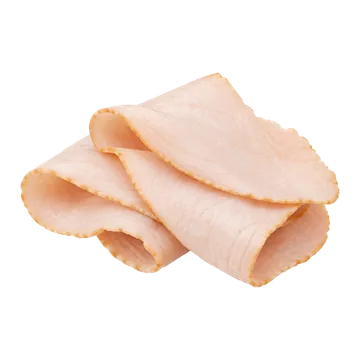 Deli turkey breast
Not rated yet for a 55 g serving
No gram figure for this foodWe have no measurement of this in this food, so there is no gram figure.How it’s rated
Not rated: EFSA's 2019 group acceptable daily intake for phosphates is 40 mg/kg body weight/day as phosphorus, but the USDA listing's total phosphorus of 249 mg/100 g cannot be split into natural and added. A 55 g serving carries 137 mg total phosphorus, about 5% of 2,800 mg. Phosphate-injected deli turkey is the common case, and no measured added-phosphate level was found.
Intake: not applicable (flag)
Measured on: no added-phosphate concentration read
 Ham, sliced
Not rated yet for a 55 g serving
No gram figure for this foodWe have no measurement of this in this food, so there is no gram figure.How it’s rated
Not rated: EFSA's 2019 group acceptable daily intake (ADI) for phosphorus is 40 mg P/kg body weight/day, but the listing's total phosphorus (153 mg/100 g for ham, 252 for water-added deli ham) cannot be split into natural and added phosphorus. A 55 g serving carries 84 mg of total phosphorus, about 3% of 2,800 mg, which is only an upper bound on the added share. No measured added-phosphate level for Canadian ham was found.
Intake: not applicable (flag)
Measured on: no added-phosphate concentration read
 Shrimp, cooked
Not rated yet for a 100 g serving
No gram figure for this foodWe have no measurement of this in this food, so there is no gram figure.US food database (USDA SR Legacy) · grade C ?
How it’s rated
Not rated: EFSA's 2019 group acceptable daily intake for phosphates is 40 mg/kg body weight/day as phosphorus, but the added amount is unknown. The USDA record says the food may contain 'additives to retain moisture', the usual role of polyphosphates in shrimp, and lists sodium at 947 mg/100 g against 566 mg in the raw entry.
Intake: not applicable (flag)
Measured on: the listing itself warns of additives; no measured phosphate in retail cooked shrimp found
Sources
- EFSA FAF Panel, Re-evaluation of phosphoric acid-phosphates - di-, tri- and polyphosphates (E 338-341, E 343, E 450-452) as food additives and the safety of proposed extension of use, EFSA J 2019;17(6):5674 (PMC7009158) · doi:10.2903/j.efsa.2019.5674 · PMID 32626329 · doi.org
efsa-2019-phosphates· full text read · CC BY (EFSA) - USDA FoodData Central, SR Legacy, 2018-04
fdc-sr-legacy-2018-04· dataset · CC0 1.0 (public domain)