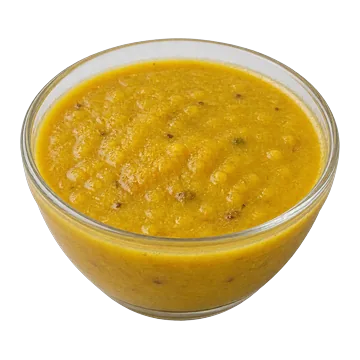
Lentils, cooked as dal
Checked by us
Too little nutrient data to say what it’s good for.
Nothing to watch.
Good for
How we counted this
What 100 g gives you: imported foods have no serving size yet.
Too few nutrient values to say. Missing nutrients are left out, not counted as zero.
Watch out
How we counted this
Nothing here reaches a limit at ordinary amounts.
Better options
How we counted this
“Better” here always means better at something the row names: more of one nutrient, more nutrients per serving, or the goal you pick. It never means better in every way.
This food has no serving size, so every amount below is for 100 g of each food, and a swap compares like with like. A serving of another food can be bigger or smaller.
Not enough nutrient values for this food to compare it.
Your goal
Your goal changes only this list, not what the food gives you or what to watch.
Not enough nutrient values for this food to compare it.
Not enough nutrient values for this food to compare it.
Bring a tracker export or describe your usual week. The same rules check all of it.
The numbers
Open every value
Name in the database: Lentils, cooked as dal
Listed nutrients, per 100 g
For each nutrient, the value this page uses is marked “used”. A row marked “second database” is another database’s figure for a matching food, kept so you can see how far databases disagree (they can differ in the samples analysed, lab methods and rounding). Its own cells are worked out from it, but none of the page’s words or scores are.
| Nutrient | How | Source | Grade |
|---|
Change the amount to rescale the first column. Nutrients a database doesn't list are missing, not zero.
Absorption studies
Studies of how much of a nutrient gets in; those done in animals are marked. This page quotes a figure only from a study that passes our screen: adults, graded A, of this food in this preparation, with a test dose on record and a source that has passed our evidence check. The exception is calcium on our calcium card: its figure comes from the card’s own study, checked with the card, and is marked “used” even where that study misses a step of this screen. The others are listed so nothing is hidden, each with the first check it fails.
No study of this food passes the screen yet, so no absorption figure is quoted.
| Study | Nutrient | Absorbed | Test dose | People | Grade | On this page |
|---|---|---|---|---|---|---|
| DellaValle 2015: iron from intrinsically 57Fe-labelled lentils prepared as dal (reference arm ferrous sulfate 23.6 +/- 13.2%) CDC Maxim, 117 g lentils in the 330 g dal (funder's project page) · prepared as dal (lentils with onions, garlic, spices; funder's project page) abstract only | Iron | 2.2 % | 8 mg | 19 | A | Not used: its source hasn’t passed our evidence check yet. |
Sources
- DellaValle DM, Glahn RP, Shaff JE, O'Brien KO. Iron absorption from an intrinsically labeled lentil meal is low but upregulated in women with poor iron status. J Nutr 2015;145:2253-7 · doi:10.3945/jn.115.217273 · PMID 26338889
pmid:26338889· abstract only · Publisher copyright (journal article)
Body map 2026-10-25.1: each nutrient’s job comes from an agency fact sheet, linked beside it under Good for.
The plain words: “a lot” means one serving (100 g when the food has no serving size) gives at least 20% of the daily amount (the reference intake), “some” at least 10%, “a little” at least 2% (the cut-offs are ours, one set for every page: 20% and 10% are borrowed from the US labelling terms “high” and “good source” and applied to Health Canada’s daily amount, whereas Health Canada’s own shopper rule says 15%; provisional: they may change in a later method version). The daily amount is Health Canada’s Dietary Reference Intake for adults 19–30; where men and women need different amounts we use the higher one (protein: 56 g for men, 46 g for women). The percentage printed under each nutrient is the printed amount as a share of that daily amount, rounded to the nearest whole number, and the word is read from that percentage, so the amount, the percentage and the word always agree. Calcium with a measured absorption is scaled by how well it gets in compared with milk.
The scale: “Nothing to watch” means a serving a day stays under the limit at ordinary amounts; “Go easy” means a serving a day can push past the limit for adults who already take in the most, or fewer than 2 servings reach it; “Limit it” means once a week or less. The dataset’s own rating is under “How we got this”. Provisional: the scale may change in a later method version.
Measured absorption under Good for: grade-A studies in adults that tested this preparation of this food, as a share of the listed amount (the share digested, for protein), quoted once each source has passed our evidence check; animal studies and other variants stay in the table above. Provisional: this screen may change in a later method version.