N-nitrosamines
Form in cured and processed meats, and when meat is cooked at high heat.
In the body: They damage DNA and caused liver tumours in animals.
Not rated by dose: a flag on 5 reviewed foods, among them Chicken thigh, roasted, Beef steak, top loin, grilled and Pork sausage, pan-fried.
No safe level known. No intake is known to be harmless, so there’s no limit to count grams up to.
The reference point, not a limit
The agency starts from a dose linked to an effect in studies, in people or in animals, and judges the margin between that dose and what people take in.
- Reference point10 µg/kg body weight/day
- That dose, for a 70 kg adult700 µg a day
Not a safe amount or an allowance: harm can’t be ruled out below it. - Basisbenchmark dose (BMDL): the lower estimate of the dose that produced a set size of effect in studies; the number after it is that size (BMDL10 is 10%, BMDL01 is 1%). A starting point rather than a limit
benchmark dose lower limit (BMDL10) for NDEA liver tumours in rats; margin of exposure (MOE) approach, MOE ≥ 10,000 = low concern (animal benchmark dose lower limit (BMDL10)) - Margin of exposure that raises concern ?10,000
A margin below this counts as a concern. A margin of exposure is the dose that caused effects in studies divided by what people take in: the smaller it is, the closer people’s intake sits to that dose. - Average adult intake EFSA 2023: total carcinogenic N-nitrosamine exposure 0 to 208.9 ng/kg body weight/day across surveys, age groups and two scenarios; mean MB scenario 1 from <0.1 (infants) to 12.0 (toddlers); P95 MOEs 3,337 to 183 (scenario 1) and 322 to 48 (scenario 2)
- Source ?EFSA 2023
Reviewed foods that carry it
5 reviewed foods carry it; none is rated by dose.
How often you can eat it ?
No grams figure for N-nitrosamines: there is no limit to count grams against. Each food shows the method’s rating instead: how much a daily serving adds to the average adult’s intake.
No food here is rated by dose. Each line says why it’s listed: a flag for the people the source names, advice on handling it, or context.
Flags and context, not rated by dose
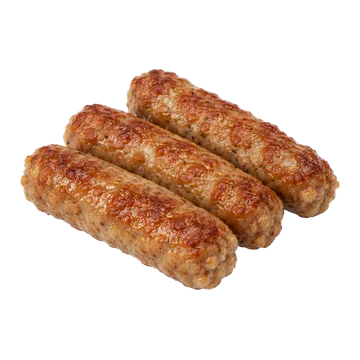 Pork sausage, pan-fried
Worth knowing
How it’s rated
Flagged: N-nitrosamines have no safe threshold, so EFSA uses margin of exposure (NDEA liver tumours, benchmark dose lower limit 10 µg/kg body weight/day). At the 95th percentile of intake the margin for total carcinogenic N-nitrosamines is highly likely (98-100% certain) below 10,000 for all age groups, which raises a health concern; EFSA's 2017 nitrite opinion puts it below 10,000 for meat products at high exposure. Cooking, frying and baking sausages can raise N-nitrosopiperidine (NPIP) and the non-volatile NMTCA. No value was read for fresh pork sausage.
Intake: not applicable (flag)
Measured on: EFSA 2023 exposure assessment: "Meat and meat products" the main contributor; cured and smoked sausage and frying are the named drivers; no value read for fresh pork sausage
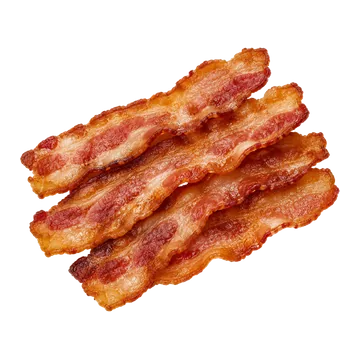 Bacon, pan-fried
Not rated yet
PubMed 26542769 · grade B ?
How it’s rated
Not rated: EFSA's 2023 reference point for NDEA, one of the N-nitrosamines, is a benchmark dose lower limit (BMDL10) of 10 µg/kg body weight/day, judged by a margin of exposure; there is no grams figure, and no mean was found to judge contribution to average intake. In 48 retail samples of cooked bacon (USDA), all results were under 15 ng/g, most under 1 ng/g. For illustration only, a 15.0 g serving at 15 ng/g of one nitrosamine is 0.225 µg, 0.0032 µg/kg body weight, a ratio of about 3,100 to the BMDL10; this is not a margin of exposure, which EFSA builds on total exposure across foods.
Intake: one 15 g reference serving a day, 70 kg adult
Measured on: Lehotay 2015 (USDA ARS), cooked bacon, 48 retail samples, pan-fried and microwaved; five NAs (NDMA, NDEA, NDBA, NPIP, NPYR), reporting limit 0.1 ng/g. Niklas 2023 (DTU, Denmark), pan-fried bacon cubes and slices: only NPIP, NPYR and NDBA found, each at or below 5 ng/g; NDMA, NDEA and NDPA not detected in any sample; non-volatile NTCA 12-77 ng/g
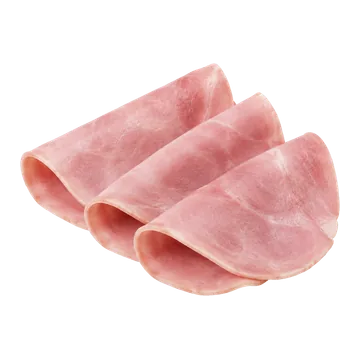 Ham, sliced
Not rated yet
How it’s rated
Not rated: EFSA's 2023 opinion uses a benchmark dose lower limit (BMDL10) of 10 µg/kg body weight/day for the nitrosamine NDEA and judges risk by margin of exposure. It names meat and meat products as the main contributor, with the margin at the 95th percentile highly likely under 10,000 for all age groups, a health concern across all foods, not ham alone. No N-nitrosamine concentration for ham was read, and cooked, sliced ham is not fried, so the formation seen in fried bacon does not apply to ham eaten cold.
Intake: not applicable (flag)
Measured on: no ham-specific measured value found or read
How it’s rated
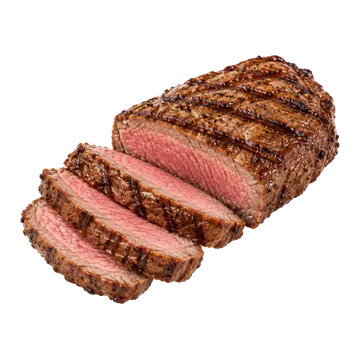
Shown as context, not rated: no safe threshold exists for N-nitrosamines, so EFSA uses margin of exposure (NDEA benchmark dose lower limit 10 µg/kg body weight/day). At the 95th percentile the margin is below 10,000 for all age groups, with meat and meat products the main source. Grilling and frying raise levels. No beef-specific level was read.
Intake: not applicable (flag)
Measured on: EFSA 2023 exposure scenario 2 (including cooked unprocessed meat and fish); no beef-specific concentration read
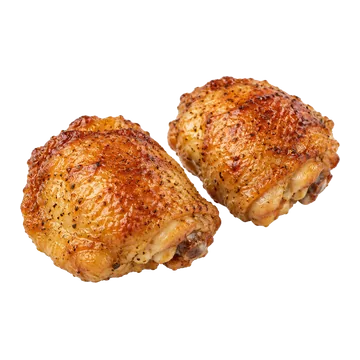 Chicken thigh, roasted
Context
How it’s rated
Shown as context, not rated: no safe limit exists for N-nitrosamines, so EFSA uses margin of exposure (NDEA benchmark dose lower limit 10 µg/kg body weight/day). At the 95th percentile the margin is highly likely below 10,000 for all age groups, which raises a health concern; meat and meat products are the main contributor. Cooking raises levels. No chicken-specific level was read.
Intake: not applicable (flag)
Measured on: EFSA 2023 exposure scenario 2 (including cooked unprocessed meat and fish); no chicken-specific concentration read
Sources
- EFSA CONTAM Panel (2023). Risk assessment of N-nitrosamines in food. EFSA Journal 21(3):e07884. PMC10043641 · doi:10.2903/j.efsa.2023.7884 · PMID 36999063 · doi.org
efsa-2023-nitrosamines· full text read · CC BY (EFSA Journal) - Lehotay SJ, Sapozhnikova Y, Han L, Johnston JJ. Analysis of Nitrosamines in Cooked Bacon by QuEChERS Sample Preparation and Gas Chromatography-Tandem Mass Spectrometry with Backflushing. J Agric Food Chem 2015;63(47):10341-10351. doi:10.1021/acs.jafc.5b04527 · PMID 26542769 · pubmed.ncbi.nlm.nih.gov
pmid:26542769· abstract only · licence not recorded