Acesulfame potassium
A sweetener in diet drinks and sugar-free foods.
In the body: The limit rests on a two-year rat study that found no harm at the highest dose tested, with a safety margin on top.
The one rated food, Diet cola, needs no cap on how often you eat it: no amount anyone really eats reaches the daily limit. One more reviewed food carries it but isn’t rated yet.
Builds up over time. Agencies set an amount you can take in every week, or every day, for life. A food measured against it shows the grams that reach it.
The limit
- The agency’s figure15 mg/kg body weight/day
- For a 70 kg adult1,050 mg a day
- Basisacceptable daily intake (ADI): what you can take in every day for life
EFSA FAF Panel 2025 acceptable daily intake (ADI) (replaces the SCF's 9 mg/kg body weight/day) (highest dose tested without adverse effects in a 2-year rat chronic toxicity and carcinogenicity study) - Average adult intake0.04–15.7 mg/kg body weight/day EFSA 2025 refined brand-loyal scenario: mean 0.04 (adolescents) to 5.2 (toddlers); P95 0.2 (adults) to 15.7 (toddlers).
- Source ?EFSA 2025
Reviewed foods that carry it
2 reviewed foods carry it, 1 of them rated by dose.
Grams to the limit ?
Grams of each food that reach the limit in its window, for a 70 kg adult. Fewest first: those are the foods to watch.
Known background: an average adult already takes in 0.04–15.7 mg/kg body weight/day. Where the dataset allows, the grams below are the room left after that intake (the median of the surveys’ averages where EFSA gives one, otherwise the highest); beside each, the same limit counted from zero, the food eaten alone.
 Diet cola
Nothing to watch: under the limit for a 375 g serving
More than anyone eatsNo realistic amount reaches the limit.30.2 mg per 375 g servingCastellanos 2025 · grade B ?
How it’s rated
The counted figure is 13,000 g a day, about 35 servings a day.
No cap: EFSA's 2025 re-evaluation set the acceptable daily intake for acesulfame K at 15 mg/kg body weight/day, replacing the earlier 9 mg/kg body weight/day, 1,050 mg a day for 70 kg. Eaten alone, about 13,057 g a day would reach it (about 35 servings; 7,465 g at the strongest product, 140.8 mg/L). One serving carries 30 mg, 2.9% of it. EFSA's mean exposure runs from 0.04 mg/kg body weight/day in adolescents to 5.2 in toddlers; at the 95th percentile, from 0.2 in children 3-9 and adults to 15.7 in toddlers, so a toddler at the 95th percentile exceeds the limit.
Intake: one 375 mL reference amount (375.4 g at 1.00101 g/mL) a day, 70 kg adult · Level in the food: 80.5 mg/L (diet cola, 1.00101 g/mL) (mean of 3 products' lot means (38.8, 140.8, 61.9 mg/L; 4 lots each), n = 3)
Measured on: Castellanos and Sanchez 2025, J Xenobiot 15(5):164, Table 3: three commercial cola sodas labelled 'zero' or 'light' with no sugars added, bought in Spain (2024), four independent lots each, HPLC with UV/fluorescence detection; mean of the three products' lot means
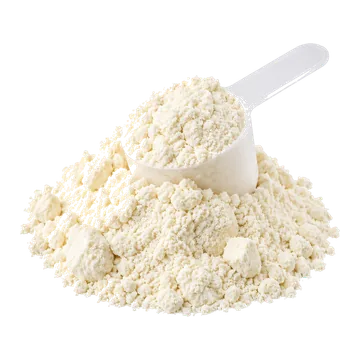 Whey protein concentrate
Not rated yet for a 30 g serving
No gram figure for this foodWe have no measurement of this in this food, so there is no gram figure.How it’s rated
Not rated: EFSA's acceptable daily intake is 15 mg/kg body weight/day (1,050 mg a day for 70 kg), but no acesulfame K level in any whey powder was found, so no grams figure. Only flavoured powders carry it; 2 of 14 whey powders in a Hungarian sample declared it.
Intake: not applicable (flag)
Measured on: flavoured whey powders sweetened with it (either variant); no concentration in any whey powder found or measured; labels not read
Sources
- Castellanos M, Sanchez JM. Determination of Artificial Sweeteners in Commercial Beverages: Do We Know What We Are Consuming? J Xenobiot 15(5):164 · doi:10.3390/jox15050164 · PMID 41149750
castellanos-2025-sweeteners· full text read · CC BY 4.0 - EFSA FAF Panel, Re-evaluation of acesulfame K (E 950) as food additive, EFSA Journal 23(4):9317 · doi:10.2903/j.efsa.2025.9317 · PMID 40309404
efsa-2025-acesulfame· full text read · CC BY-ND